
Straight answers — no scare tactics · 18 pages and growing
Mold, Health & Your Home
What mold in a home actually means: identification, smells, moisture sources, and when testing or remediation is worth it.
Below the surface · Mold
Where mold hides — the places a flashlight never reaches
Mold grows where moisture sits and light doesn't — which is why what you can see is rarely the whole colony. These are the places we check on every remediation.
Tap or Tab to a numbered point on the diagram to see what happens there — and how we resolve it. Every point is also written out in the list below.
All 8 points, written out
-
Behind drywall & wallpaper
Often invisible
The backside of drywall and the paste under wallpaper feed mold in the dark — a wall can look clean while the cavity side is colonized.
Summit: We inspect with moisture meters and open walls under containment, so spores don't spread to clean rooms.
-
Under carpet & pad
Often invisible
Carpet pad holds moisture for days after a leak, and mold establishes between pad and subfloor before any smell reaches the room.
Summit: We lift flooring at the wet edge, remove unsalvageable pad, and treat the subfloor beneath it.
-
Attic roof sheathing
Often invisible
Roof leaks and poor attic ventilation let condensation feed mold across the underside of the roof deck — invisible unless someone climbs up.
Summit: We remediate the sheathing and flag the ventilation or leak problem that caused it.
-
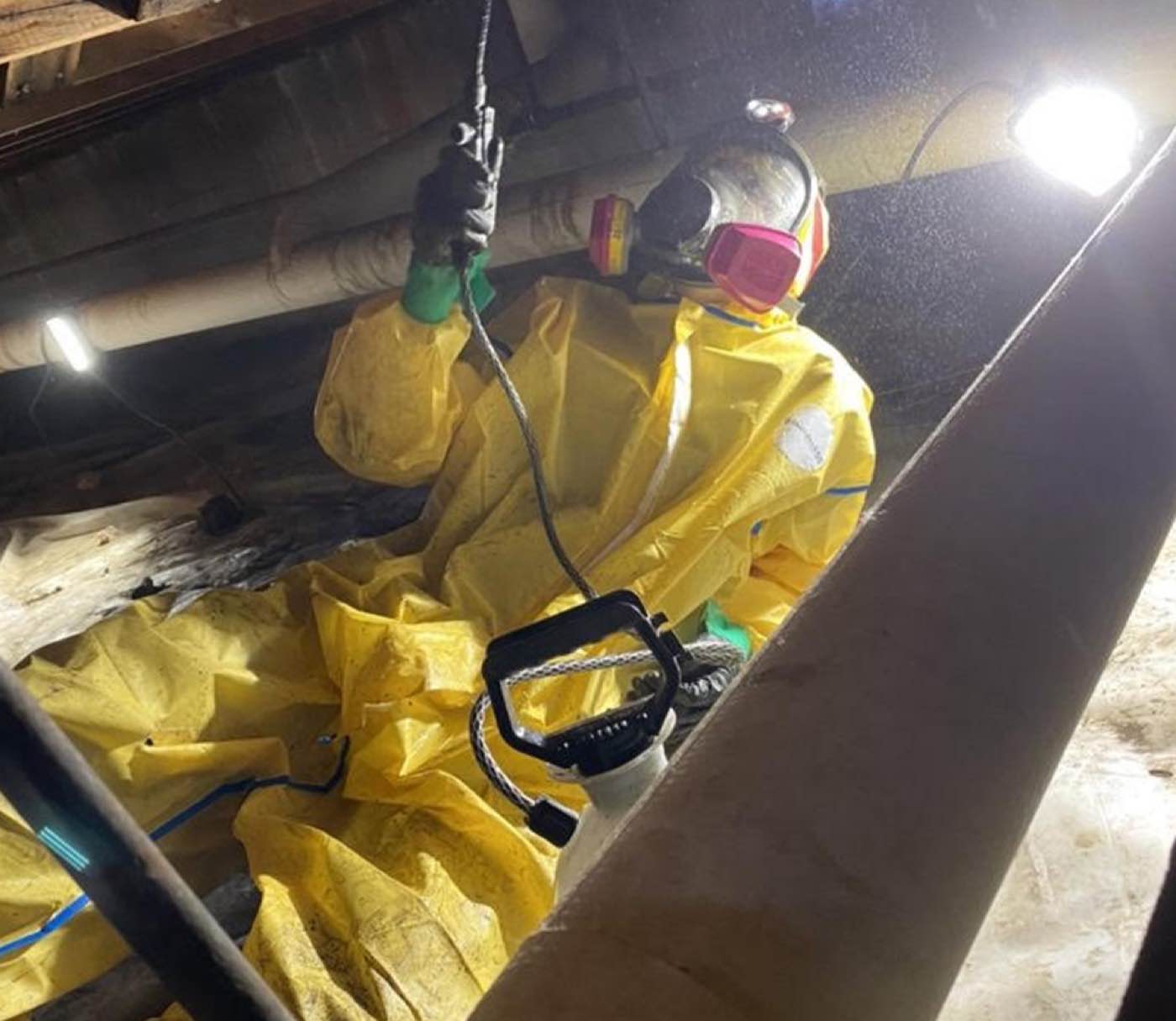
Crawl space framing
Often invisible
Damp Pacific Northwest crawl spaces grow mold on joists and posts that quietly affects the air in the living space above.
Summit: Our crews suit up and remediate crawl space framing directly — it's some of our most common work.
-
Inside the HVAC system
Often invisible
Moisture in ducts or at the air handler lets mold grow inside the one system that touches every room.
Summit: We inspect the HVAC system during remediation and clean it when growth or spore load calls for it.
-
Window sills & frames
Visible
Winter condensation on windows feeds mold along sills, frames, and the wall below — one of the few places you can watch it happen.
Summit: We clean the visible growth and check whether the wall below the window is wet inside.
-
Spores in the air
Often invisible
Disturbed mold releases spores that circulate house-wide, which is how a basement problem becomes a bedroom symptom.
Summit: We work under containment with negative air and HEPA filtration so remediation doesn't spread the problem.
-
The moisture source
Often invisible
Every colony has a water source — a slow leak, condensation, or ground moisture. Kill the mold without finding it and the mold returns.
Summit: We trace the moisture to its source and make fixing it part of the scope, not a footnote.
Worried any of these points describes your home? Moisture meters and a trained eye settle it in one visit — the look is free.
Identification
What Does Mold Smell Like?
Mold smells musty, earthy, damp — like wet cardboard or a closed-up basement. What the smell means, why you smell it before you see it, and what to do next.
Read more Updated July 2026Signs of Mold in a House: What to Look (and Smell) For
Musty odor, streaked staining, bubbling paint, warped materials, and a moisture history — the signs of mold in a house, in order.
Read more Updated July 2026Why Does My House Smell Musty?
A musty smell usually means hidden moisture feeding mold. Where the odor comes from, how to trace it to its source, and when to get a moisture inspection.
Read moreBlack mold
Black Mold: The Definitive Guide
What black mold actually is, the honest health picture, how to tell it from look-alikes, and how it's removed safely — the complete no-panic guide.
Read more Updated July 2026Black Mold in the Shower: Causes and Fixes
Why black spots grow in showers, whether it's dangerous, how to clean grout and caulk safely, and the sign that shower mold has spread behind the wall.
Read moreHealth & exposure
Warning Signs of Mold Toxicity: An Honest Look
What people mean by mold toxicity, the symptoms linked to damp indoor air, where the science is unsettled, and why a doctor — not a website — is the answer.
Read more Updated July 2026Mold Allergy Symptoms: What to Know
The symptoms commonly linked to a mold allergy, how it differs from a cold, when to see a doctor, and how removing indoor mold reduces the exposure behind it.
Read more Updated July 2026Is Black Mold Dangerous? The Honest Answer
The evidence-based answer on black mold and health: what it can cause, who's most sensitive, where the science is unsettled, and why removal matters regardless.
Read more Updated July 2026Mycotoxins in Homes: What's Known and What Isn't
What mycotoxins are, what the science does and doesn't establish about home exposure, why 'toxic mold' claims outrun the evidence, and what to actually do.
Read moreMold species & colors
White Mold: What It Is and What to Do
What white mold is, how to tell it from efflorescence and mildew, why it shows up in crawl spaces and basements, and when to remove it professionally.
Read more Updated July 2026Penicillium and Aspergillus in Homes
What Penicillium and Aspergillus molds are, why they're among the most common indoor molds, the honest health picture, and how they're removed and prevented.
Read more Updated July 2026Cladosporium: The Most Common Household Mold
What Cladosporium is, why it's one of the most common indoor and outdoor molds, the honest allergy picture, and how to remove and prevent it at home.
Read more Updated July 2026Stachybotrys: The Real 'Black Mold'
What Stachybotrys chartarum actually is, why it earned the 'black mold' reputation, what the science honestly supports, and how it's removed safely.
Read moreWhere mold grows
Mold in Carpet: Causes, Risks, and Removal
How mold gets into carpet and padding, why wet carpet is a 48-hour clock, when carpet can be saved versus replaced, and how to handle it safely.
Read more Updated July 2026Mold on Drywall: Can It Be Cleaned or Must It Go?
Why drywall is mold-prone, whether painted drywall can be cleaned versus cut out, why bleaching rarely works, and when growth means water is inside the wall.
Read more Updated July 2026Bathroom Mold: Why It Grows and How to Stop It
Why bathrooms grow mold, the difference between surface mildew and a hidden leak, how ventilation stops it, and when bathroom mold needs a professional.
Read more Updated July 2026Mold on Windows: Condensation, Causes, and Fixes
Why mold grows on window frames and sills, how condensation and humidity drive it, how to clean it safely, and when it points to a bigger moisture problem.
Read more Updated July 2026Attic Mold: Causes, Risks, and How to Fix It
Why attics grow mold — poor ventilation, roof leaks, and bath fans venting into the attic — how to tell the cause, and how it's remediated and prevented.
Read moreWhen reading turns into needing help.
One call reaches a live Summit coordinator, 24 hours a day — serving Oregon and SW Washington since 1978.