
Oregon's wildfire seasons have made smoke an indoor problem far from any flame. After days of hazardous air, homes hold it: odor in soft goods, fine residue on surfaces, particulates through HVAC systems — miles from the nearest fire line.
Most smoke-event cleanup is genuinely DIY-able. This guide covers what works, what doesn't, and the situations — heavy or repeated smoke loading, nearby-fire residue, sensitive occupants — where professional treatment earns its cost.
What does wildfire smoke actually leave behind indoors?
Three things: fine particulate settled on every horizontal surface, odor compounds absorbed into porous materials (fabrics, carpet, unfinished wood, paper), and whatever your HVAC system inhaled — filters, coils, and duct interiors. Severity scales with exposure: days of smoky air is one tier; visible ash or proximity to an active fire is another.
That tiering matters because it decides how much of this is a weekend of cleaning versus a restoration project.
What DIY cleaning actually helps after a smoke event?
The effective sequence, top down:
- Replace HVAC filters first (consider upgrading filter grade if your system supports it) — then let the system help clean the air
- Damp-wipe hard surfaces top-down with appropriate cleaner; dry dusting just relocates fine ash
- Launder washables (bedding, curtains, clothing) — washing works well on smoke odor in fabrics
- Vacuum carpets and upholstery slowly, ideally with a HEPA-equipped machine
- Run portable HEPA air cleaners in occupied rooms; ventilate hard once outdoor air clears
- Wipe window tracks, sills, and entry areas — the infiltration paths hold the most residue
What about the HVAC system and ducts?
The system that ran during the smoke event filtered what it could and coated what it couldn't. Filters are the easy fix; the honest duct answer is 'it depends on loading.' After a normal regional-smoke summer, fresh filters and time usually suffice. After heavy loading — visible residue at registers, persistent odor when the system runs, ash intrusion — duct and system cleaning is legitimate.
We'll give you the straight answer either way: we inspect first, and 'your ducts are fine' is a result we deliver regularly — see residential air duct cleaning for how that inspection works.
When does professional smoke treatment make sense?
When odor persists after thorough DIY cleaning (compounds absorbed deep in porous materials need source treatment or specialized deodorization), when the home took real residue from a nearby fire (that's fire-restoration territory with proper cleaning standards, and possibly an insurance claim), or when occupant health makes thoroughness non-negotiable — in which case air-quality questions belong with your doctor while we handle the building side.
Professional deodorization treats sources rather than masking: cleaning residue from surfaces and cavities, treating or removing what can't be cleaned, and neutralizing structure and contents under IICRC fire-restoration standards.
How do I harden the house for next season?
Before smoke season: know how to set HVAC to recirculate, stock spare filters and consider a higher filtration grade, seal the obvious infiltration gaps (weatherstripping pays for itself in smoke season too), and have portable HEPA units for bedrooms. During events, minimize door traffic and run the cleaners where people sleep.
If a smoke event does turn into a damage event — ash intrusion, nearby-fire residue, or an insurance claim worth filing — document conditions with photos before cleanup, same as any loss. Summit's line is answered 24/7 (800-769-1553).
Below the surface · Fire & smoke damage
Where smoke goes after the fire is out — the whole-house map
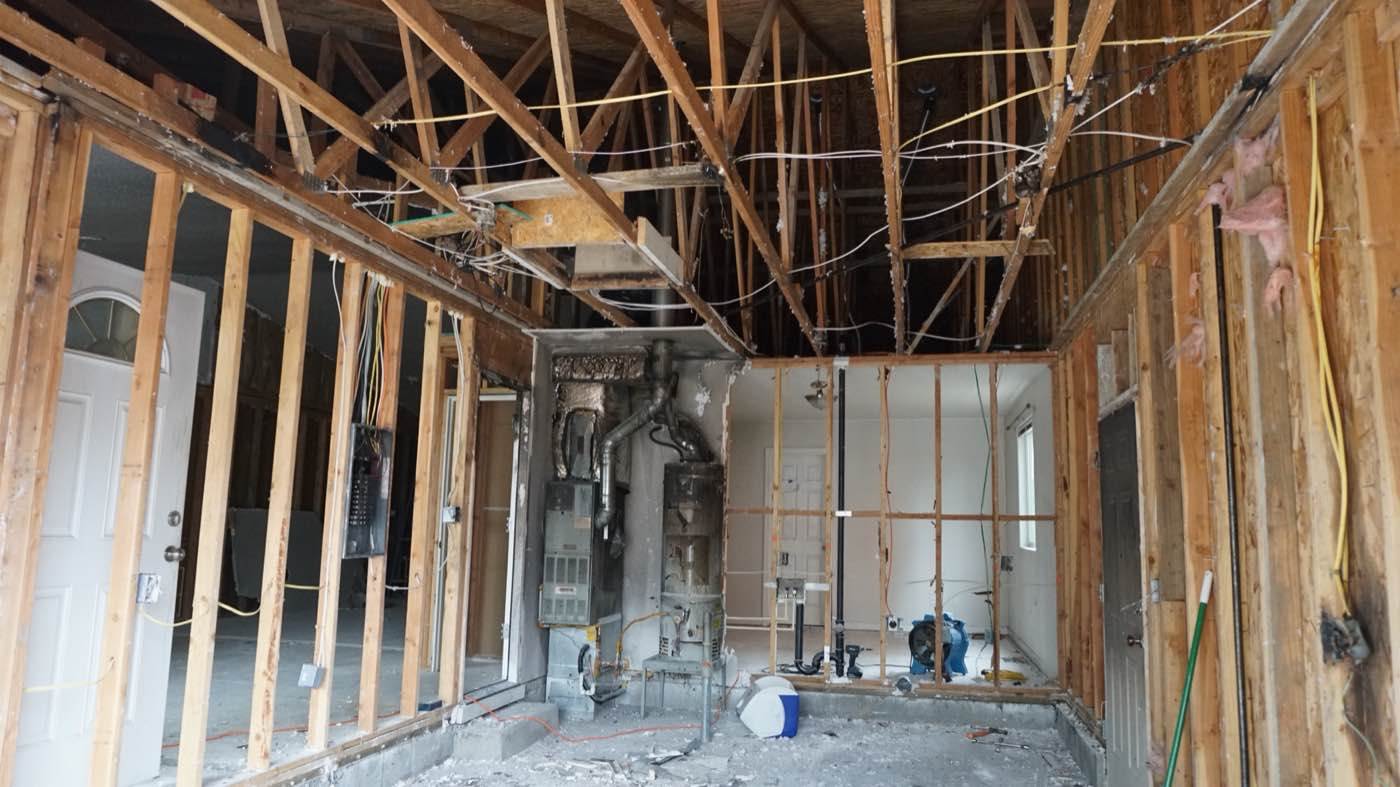
Flames damage one room; smoke, soot, and firefighting water reach the whole house. Here's where a fire loss actually travels — and why cleanup is more than repainting.
Tap or Tab to a numbered point on the diagram to see what happens there — and how we resolve it. Every point is also written out in the list below.
All 7 points, written out
-
Soot in the HVAC system
Often invisible
Smoke travels through ductwork during the fire, and a contaminated system can re-spread soot and odor to cleaned rooms for weeks.
Summit: We evaluate and clean the HVAC system as part of the fire scope, not as an afterthought.
-
Smoke inside wall cavities
Often invisible
Pressurized smoke pushes through outlets, gaps, and top plates into wall cavities, leaving residue where no brush can reach.
Summit: We check cavities near the loss with meters and open or seal them based on what the readings show.
-
Attic smoke & insulation
Often invisible
Hot smoke rises into the attic, where loose insulation soaks up odor that drifts back down every warm day.
Summit: We inspect the attic on every significant smoke loss and remove odor-loaded insulation when cleaning can't recover it.
-
Odor absorbed into framing & soft goods
Often invisible
Framing, carpet, upholstery, and clothing absorb smoke odor at a molecular level — surface wiping alone won't remove it.
Summit: We pair source cleaning with odor strategies like hydroxyl treatment, chosen for occupied homes.
-
Corrosive residue on electronics & wiring
Often invisible
Soot is acidic — it etches circuit boards, wiring, and metal finishes in the days after the fire, even in rooms that never saw flame.
Summit: We prioritize assessing and cleaning electronics early, before corrosion becomes permanent.
-
Water damage from firefighting
Visible
The water that put the fire out soaks floors, walls, and everything below the fire room — most fire losses are also water losses.
Summit: We run structural drying alongside fire cleanup so a fire claim doesn't quietly become a mold claim.
-
Structural charring behind finishes
Often invisible
Fire can char framing inside walls and ceilings while the drywall over it looks merely smoke-stained.
Summit: We expose and evaluate the structure where heat traveled, and rebuild under Oregon CCB# 153107 and Washington L&I# SUMMICG857ML licensing.
Worried any of these points describes your home? Moisture meters and a trained eye settle it in one visit — the look is free.
Questions we hear about this
Is wildfire smoke damage covered by homeowners insurance?
Smoke damage from a wildfire is often a covered peril — but claims for regional-haze exposure (vs. direct residue from a nearby fire) vary in how carriers treat them. Document conditions, ask your carrier or agent, and get a professional assessment if residue is significant.
Do ozone generators or 'odor bombs' fix smoke smell?
Approach with caution: ozone at effective concentrations is a lung irritant, treatment happens in unoccupied spaces, and consumer foggers mostly mask. Professional deodorization chooses methods per material and situation — source removal first, always.
Should I run the AC during a smoke event?
Yes, set to recirculate with a good filter — moving indoor air through filtration beats still air. Avoid settings that pull outside air until conditions clear, then ventilate thoroughly.
The smoke smell comes back on humid days — why?
Humidity re-activates odor compounds absorbed in porous materials — classic evidence the source is still in the house (carpet pad, unfinished wood, wall cavities) and a sign that source-level treatment, not another round of surface cleaning, is the fix.
Next step
You understand the problem — now weigh your options.
Side-by-side comparisons show where DIY genuinely works, what the methods differ on, and how restoration companies actually vary.