
After the fire department leaves, you're standing in front of a house that's suddenly a project — and the decisions made in the first 24 hours shape the months that follow.
This guide covers the first day in order: safety and re-entry, securing the structure, the insurance calls, essentials to retrieve, and why soot is one thing you should not start scrubbing yourself.
When is it safe to go back inside?
Only when the fire department says so — and even then, only briefly and carefully. Structures hide damage: roof members weakened by burn-through, saturated ceilings from hose water, electrical systems compromised by heat.
Treat the first re-entry as a retrieval trip, not a move back in. If officials haven't released the structure, don't enter at all.
Why does the property need to be secured today?
An open structure is exposed twice over: to weather through broken windows and roof breaches, and to liability and theft while it stands empty. Most policies also require you to take reasonable steps to protect the property from further damage.
Board-up and roof tarping are the standard first-day moves — they stop rain intrusion (a serious issue most of the year in western Oregon) and document that you protected the property. Summit crews handle emergency board-up and tarping as part of storm and fire response, around the clock.
Who do I call first — and what do I say?
Call your insurance carrier's claim line and report the loss; you'll get a claim number and, soon after, an adjuster assignment. Say what happened, when, and that you're arranging emergency stabilization. You don't need damage totals yet.
Then line up your restoration contractor. In Oregon and Washington you choose your own — carriers can suggest companies, but the decision is yours. Bringing your contractor in early means the scope of loss is documented from day one, before cleanup disturbs the evidence.
What should I retrieve in the first trip?
Grab these if they're accessible and safe:
- Identification, wallets, and checkbooks
- Medications and eyeglasses — ask your pharmacy about replacements for anything contaminated
- Phones, laptops, and chargers
- Insurance policies and key documents (or note where they are for the pack-out team)
- Irreplaceables within reach: photos, small heirlooms
Why shouldn't I start cleaning soot myself?
Soot is acidic, oily, and chemically varied depending on what burned. The wrong cleaning method sets stains permanently into surfaces that professional cleaning could have saved — wiping painted walls with a wet rag is the classic example.
Smoke odor works the same way: masking sprays fail because the odor source is in materials and cavities. Removal means source cleaning, treating or removing affected materials, and neutralizing the structure — certified work under IICRC fire-restoration standards. Summit is an IICRC certified firm, and contents (textiles, documents, electronics) have their own restoration paths through our contents team.
Where will we live during the rebuild?
Most homeowner policies carry Additional Living Expense (ALE) or Loss of Use coverage for temporary housing after a covered fire — ask your adjuster about it on the first call, and keep every receipt.
It's also a place a good contractor advocates for you. In one Summit project, the team helped a displaced homeowner secure temporary housing during repairs on top of the restoration itself — the kind of coordination that should be normal, not exceptional.
Below the surface · Fire & smoke damage
Where smoke goes after the fire is out — the whole-house map
Flames damage one room; smoke, soot, and firefighting water reach the whole house. Here's where a fire loss actually travels — and why cleanup is more than repainting.
Tap or Tab to a numbered point on the diagram to see what happens there — and how we resolve it. Every point is also written out in the list below.
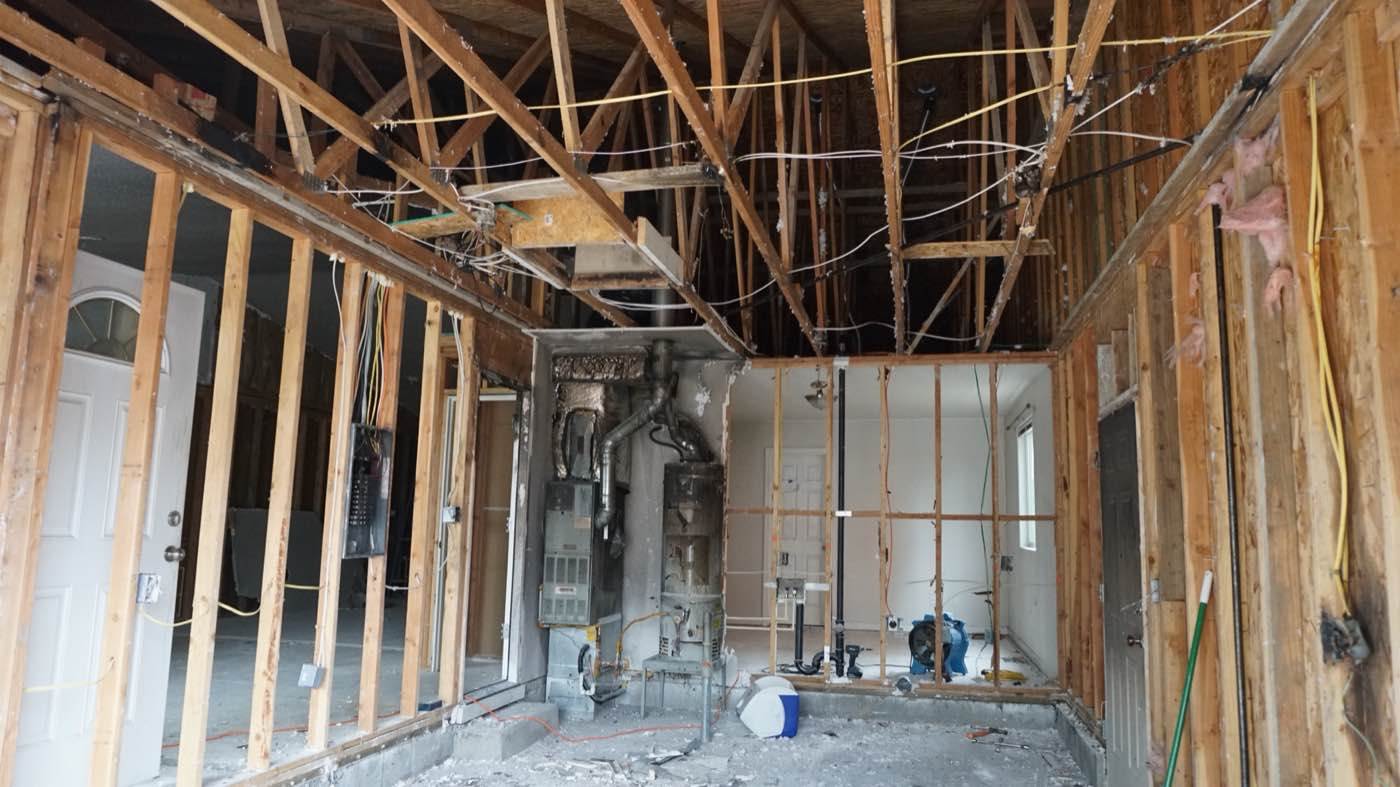
All 7 points, written out
-
Soot in the HVAC system
Often invisible
Smoke travels through ductwork during the fire, and a contaminated system can re-spread soot and odor to cleaned rooms for weeks.
Summit: We evaluate and clean the HVAC system as part of the fire scope, not as an afterthought.
-
Smoke inside wall cavities
Often invisible
Pressurized smoke pushes through outlets, gaps, and top plates into wall cavities, leaving residue where no brush can reach.
Summit: We check cavities near the loss with meters and open or seal them based on what the readings show.
-
Attic smoke & insulation
Often invisible
Hot smoke rises into the attic, where loose insulation soaks up odor that drifts back down every warm day.
Summit: We inspect the attic on every significant smoke loss and remove odor-loaded insulation when cleaning can't recover it.
-
Odor absorbed into framing & soft goods
Often invisible
Framing, carpet, upholstery, and clothing absorb smoke odor at a molecular level — surface wiping alone won't remove it.
Summit: We pair source cleaning with odor strategies like hydroxyl treatment, chosen for occupied homes.
-
Corrosive residue on electronics & wiring
Often invisible
Soot is acidic — it etches circuit boards, wiring, and metal finishes in the days after the fire, even in rooms that never saw flame.
Summit: We prioritize assessing and cleaning electronics early, before corrosion becomes permanent.
-
Water damage from firefighting
Visible
The water that put the fire out soaks floors, walls, and everything below the fire room — most fire losses are also water losses.
Summit: We run structural drying alongside fire cleanup so a fire claim doesn't quietly become a mold claim.
-
Structural charring behind finishes
Often invisible
Fire can char framing inside walls and ceilings while the drywall over it looks merely smoke-stained.
Summit: We expose and evaluate the structure where heat traveled, and rebuild under Oregon CCB# 153107 and Washington L&I# SUMMICG857ML licensing.
Worried any of these points describes your home? Moisture meters and a trained eye settle it in one visit — the look is free.
Questions we hear about this
Can anything with smoke odor be saved?
Much of it, yes — but by category. Hard-surface contents clean well; textiles and upholstery need specialty processes; some porous items aren't economical to save. A contents team inventories, cleans, and stores what's salvageable and documents what isn't for your claim.
Do I need a separate company for rebuild after cleanup?
Not necessarily — and one accountable scope has real advantages for your claim. Summit handles mitigation through reconstruction, so the same company that documented the loss carries it to the final walkthrough, backed by a 1-year unconditional labor warranty on our installation work.
What if the fire started at a neighbor's property?
Report it to your own carrier anyway — your policy responds first, and the carriers sort out responsibility between themselves afterward. Don't wait on someone else's insurance to stabilize your home.
How fast can a restoration crew be on site?
Summit's 2-Hour Emergency Guarantee covers active fire emergencies: on site within 2 hours anywhere in our Oregon and SW Washington service area, with the line answered live 24/7 at 800-769-1553.
Next step
You understand the problem — now weigh your options.
Side-by-side comparisons show where DIY genuinely works, what the methods differ on, and how restoration companies actually vary.