
The first hour of a flooded basement decides how much of your home you save. Water spreads laterally through flooring and wicks up walls — every hour it stands, more materials cross the line from dry-out to tear-out.
Here's the exact order of operations Summit coordinators walk callers through at 2 a.m., written down so you can act before any crew — ours or anyone's — arrives.
First: is it safe to be down there?
Before anything else, answer two questions. Is the water touching electrical outlets, appliances, or your panel? And could it be contaminated — from a sewer line, sump failure, or outside groundwater?
If water has reached outlets or appliances, or you can't tell, stay out until the power to that level is off. If the water smells foul or came up a drain, treat it as contaminated and keep people and pets away — sewage cleanup is its own discipline for a reason.
How do I stop the water at the source?
For a burst pipe or failed supply line, close the main shutoff valve — usually where the water line enters the house (crawl space wall, garage, or near the water heater). Every adult in the house should know where this valve is before an emergency; if you're reading this on a dry day, go find it now.
If the main valve won't close or the source is outside your home, your water utility can shut service at the meter. For appliance failures (water heater, washer), close the fixture's own supply valve first if you can reach it safely.
What should I photograph before touching anything?
Your insurance claim is built on documentation, and the strongest evidence is the scene before cleanup starts. Take wide shots of each affected room, close-ups of the water line on walls and furniture, the source of the water if visible, and any damaged belongings where they sit.
Photograph serial-number plates on damaged appliances and electronics. You do not need to inventory everything perfectly in hour one — but a few minutes of photos protects you for the entire claim.
What's actually worth moving in the first hour?
Move what's irreplaceable, absorbent, or wicking: photo albums and documents, rugs, upholstered furniture, cardboard boxes, and anything electronic that's above the water but in a humid room. Put furniture legs on foil or blocks if you can't move the piece.
Skip carpet removal, drywall decisions, and anything that involves prying or cutting — those calls should follow moisture readings, not guesses.
Should I run fans and a shop vac, or wait?
A wet/dry vacuum on clean water is genuinely useful in the first hour — every gallon out now is drying time saved. Fans are more nuanced: on clean water they help; on suspected sewage or visible mold they spread contamination, so leave air movement to a crew with containment.
What consumer equipment can't do is reach the water you can't see — inside wall cavities, under flooring, in insulation. That's why professional drying uses moisture meters and daily readings rather than a look-and-feel judgment. Structural drying typically runs about three to five days with proper equipment.
When should I call for professional help?
Call while you're doing the steps above, not after — dispatch and your own first hour work run in parallel. Summit's line (800-769-1553) is answered live 24/7, and our 2-Hour Emergency Guarantee means we're on site within 2 hours for an active water loss anywhere in our Oregon and SW Washington service area.
One caller put it this way after a storm loss: “Despite numerous calls that evening, Summit responded and began working immediately.” That's the standard the guarantee exists to protect.
Below the surface · Water damage
What water damage really touches — a look inside the walls
The puddle you can see is usually the smallest part of a water loss. Water wicks, travels, and pools out of sight — tap each numbered point to see where it goes and how we resolve it.
Tap or Tab to a numbered point on the diagram to see what happens there — and how we resolve it. Every point is also written out in the list below.
All 9 points, written out
-
Drywall above the water line
Often invisible
Standing water wicks up through drywall well above the stain you can see, so a 2-inch puddle can mean 2 feet of wet wall.
Summit: We map the true moisture line with meters and dry or remove drywall to that line — not just to the visible stain.
-
Wall-cavity insulation
Often invisible
Fiberglass insulation inside the wall soaks up water, compresses, and holds moisture against the framing long after surfaces feel dry.
Summit: We open the cavity where readings call for it, remove saturated insulation, and dry the framing directly.
-
Subfloor & underlayment
Often invisible
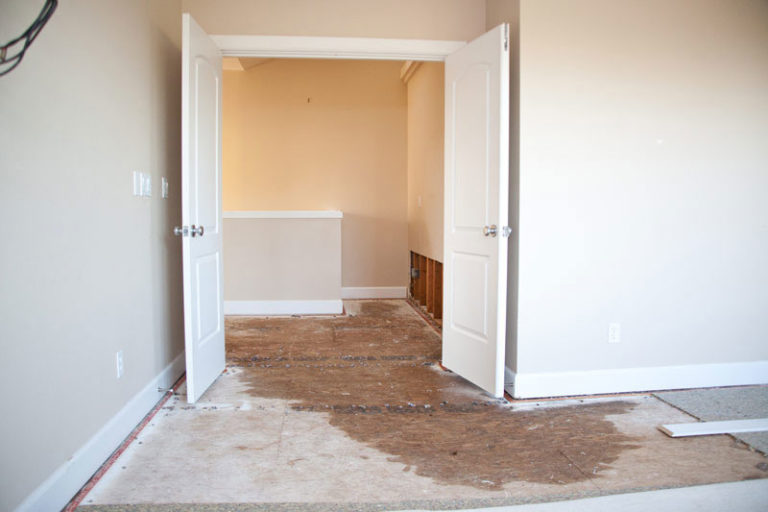
Water slips between flooring layers, swelling the underlayment and subfloor beneath finishes that still look fine on top.
Summit: We lift flooring where needed and dry or replace the subfloor so the new floor goes down on a sound, dry base.
-
Hardwood cupping
Visible
Hardwood boards absorb moisture from below and curl upward at the edges — cupping you can see and feel underfoot.
Summit: Caught early, specialty drying mats can often save cupped hardwood instead of tearing it out.
-
Cabinet toe-kicks
Often invisible
Water pools in the enclosed void under cabinets, where it can't evaporate and quietly damages the cabinet base.
Summit: We remove kick plates and move air through the void so cabinets dry in place whenever possible.
-
Sill plates & framing
Often invisible
The wood plates at the base of every wall sit right in the water path and can be critically wet within the first hour.
Summit: We direct-dry structural framing and log moisture readings until it verifiably meets dry standard.
-
Crawl space pooling & vapor
Often invisible
Water finds the crawl space, where it pools on the vapor barrier and feeds humidity back up into the house for weeks.
Summit: We extract standing water, dry the crawl space, and address the vapor barrier so moisture stops migrating upward.
-
HVAC ducts
Often invisible
Wet ductwork spreads humidity — and anything growing in it — to every room the system serves.
Summit: We inspect ducts on water losses and clean or dry them before the system runs again.
-
The 24–48 hour mold window
Often invisible
In Oregon's damp climate, hidden moisture behind baseboards and inside cavities can start growing mold within 24–48 hours.
Summit: We respond 24/7 and dry to standard fast, precisely because that window is short.
Worried any of these points describes your home? Moisture meters and a trained eye settle it in one visit — the look is free.
Questions we hear about this
Does homeowners insurance cover a flooded basement?
Homeowners policies may provide coverage for sudden and accidental water losses, such as certain plumbing or appliance failures, while other causes of water damage may be limited or excluded. Flooding, groundwater, long-term leakage, maintenance-related conditions, deductibles, limits, and exclusions vary by policy. Your insurance carrier or agent can explain how your specific policy applies. Summit's role is to document the cause and extent of the physical damage and the restoration work required.
How long can wet carpet and drywall sit before they're ruined?
There's no single safe number — it depends on water category, materials, and airflow — but the practical rule is that damage compounds by the hour, and porous materials that stay saturated invite microbial growth within days. Fast extraction is the difference between drying and demolition.
Should I turn off my furnace or HVAC after a flood?
If ducts or the air handler may have taken water, yes — running the system can push moisture and contaminants through the house. Have the system checked before restarting it.
Do I need to wait for my insurance adjuster before cleanup starts?
No — and waiting can hurt you. Policies expect you to take reasonable steps to prevent further damage, and emergency mitigation protects both your property and your claim. Document first, then stabilize.
Next step
You understand the problem — now weigh your options.
Side-by-side comparisons show where DIY genuinely works, what the methods differ on, and how restoration companies actually vary.