
If western Oregon has a signature mold problem, it lives in the crawl space. The region's homes sit over damp ground for eight wet months a year, and the crawl space is where that moisture meets wood framing, insulation, and still air — usually unobserved for years at a time.
Here's why it happens, how it announces itself upstairs, and what fixing it properly involves.
Why are PNW crawl spaces so mold-prone?
Three compounding reasons. First, ground moisture: our water table and rainfall keep crawl space soil damp most of the year, and damp soil evaporates continuously into the space above it. Second, the vapor barrier that's supposed to stop that evaporation is often missing, torn, or was never lapped and sealed properly. Third, the air barely moves — vents intended for airflow often just admit humid outside air in the wet season.
Add organic food (wood joists, subfloor, paper-faced insulation) and you have the full recipe running quietly under the house.
How does a crawl space problem show up inside the house?
The upstairs symptoms we hear before anyone looks down there:
- Musty odor that's strongest near floor registers or in first-floor rooms
- Cupping or peaking hardwood floors — moisture pushing up from below
- Cold, damp-feeling floors and unexplained indoor humidity
- Allergy-type reactions that ease when people leave the house
- Sagging or stained subfloor visible from below, insulation falling from joist bays
Isn't more ventilation the fix?
Often no — this is the persistent myth. In our climate, open vents in the wet season pull in air that's already saturated; venting a crawl space with 90% humidity outdoor air doesn't dry anything. Modern practice in the PNW increasingly favors sealing and conditioning: ground vapor barriers, sealed vents, and mechanical drying or conditioned air.
The right answer is house-specific — drainage, grading, and construction all matter — which is why the fix should follow an actual moisture assessment rather than a rule of thumb.
What does crawl space mold remediation involve?
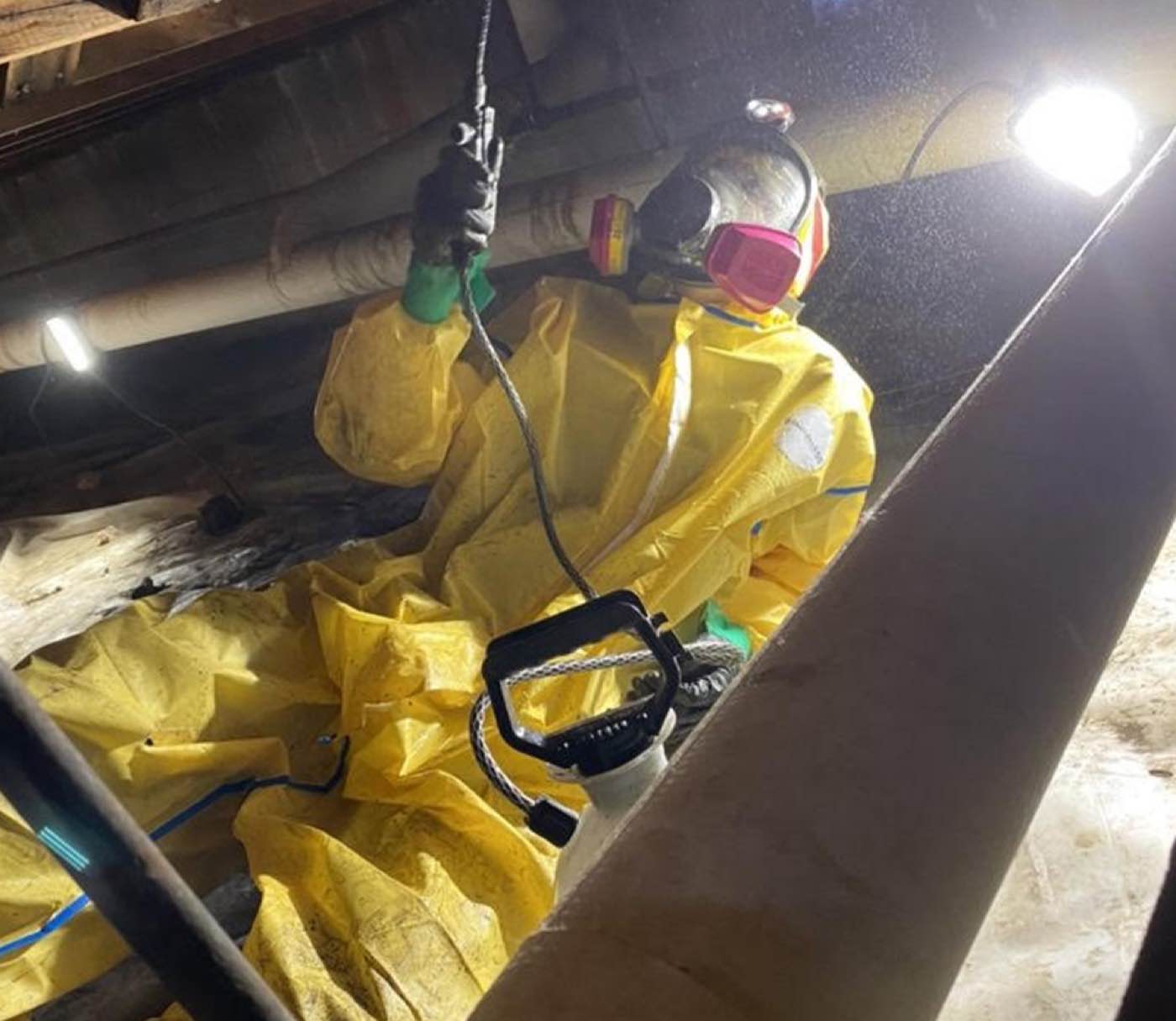
The sequence: assessment and moisture mapping; removal of contaminated insulation and debris; cleaning or treatment of affected framing under containment; drying the space to verified targets; then the prevention layer — vapor barrier, drainage corrections, and ventilation or sealing strategy so the colony doesn't return.
Summit crews do this work under IICRC mold-remediation standards across Oregon and SW Washington. Where a moisture source involves plumbing or drainage repairs, one scope carries diagnosis through remediation to repair.
What maintenance keeps it from coming back?
Twice a year — fall and spring — give the crawl space ten minutes: vapor barrier intact and fully covering soil, no standing water or new water lines on posts, insulation in place, no new odor. Keep gutters clear and downspouts discharging away from the foundation; a surprising share of crawl space water is roof water delivered to the foundation line.
After any plumbing leak or water loss above, verify the crawl space actually dried — it's the place drying gets skipped, and where we most often find the evidence years later.
Below the surface · Mold
Where mold hides — the places a flashlight never reaches
Mold grows where moisture sits and light doesn't — which is why what you can see is rarely the whole colony. These are the places we check on every remediation.
Tap or Tab to a numbered point on the diagram to see what happens there — and how we resolve it. Every point is also written out in the list below.
All 8 points, written out
-
Behind drywall & wallpaper
Often invisible
The backside of drywall and the paste under wallpaper feed mold in the dark — a wall can look clean while the cavity side is colonized.
Summit: We inspect with moisture meters and open walls under containment, so spores don't spread to clean rooms.
-
Under carpet & pad
Often invisible
Carpet pad holds moisture for days after a leak, and mold establishes between pad and subfloor before any smell reaches the room.
Summit: We lift flooring at the wet edge, remove unsalvageable pad, and treat the subfloor beneath it.
-
Attic roof sheathing
Often invisible
Roof leaks and poor attic ventilation let condensation feed mold across the underside of the roof deck — invisible unless someone climbs up.
Summit: We remediate the sheathing and flag the ventilation or leak problem that caused it.
-
Crawl space framing
Often invisible
Damp Pacific Northwest crawl spaces grow mold on joists and posts that quietly affects the air in the living space above.
Summit: Our crews suit up and remediate crawl space framing directly — it's some of our most common work.
-
Inside the HVAC system
Often invisible
Moisture in ducts or at the air handler lets mold grow inside the one system that touches every room.
Summit: We inspect the HVAC system during remediation and clean it when growth or spore load calls for it.
-
Window sills & frames
Visible
Winter condensation on windows feeds mold along sills, frames, and the wall below — one of the few places you can watch it happen.
Summit: We clean the visible growth and check whether the wall below the window is wet inside.
-
Spores in the air
Often invisible
Disturbed mold releases spores that circulate house-wide, which is how a basement problem becomes a bedroom symptom.
Summit: We work under containment with negative air and HEPA filtration so remediation doesn't spread the problem.
-
The moisture source
Often invisible
Every colony has a water source — a slow leak, condensation, or ground moisture. Kill the mold without finding it and the mold returns.
Summit: We trace the moisture to its source and make fixing it part of the scope, not a footnote.
Worried any of these points describes your home? Moisture meters and a trained eye settle it in one visit — the look is free.
Questions we hear about this
Is crawl space mold dangerous to the people upstairs?
Crawl space air moves upward into the living space (the stack effect), carrying spores and mustiness with it — so a contaminated crawl space is an indoor-air-quality issue, not just a structural one. Extent and personal sensitivity determine how much it matters; the fix is the same either way.
Can I just put lime or bleach down there?
No — surface chemicals don't address colonized wood, torn vapor barriers, or the moisture source, and working chemicals in a confined space is its own hazard. Crawl spaces are one of the clearest cases for professional containment and removal.
Does homeowners insurance cover crawl space mold?
Coverage for mold remediation varies by policy and by the circumstances that caused the growth. Some policies contain specific limitations or exclusions, and crawl space conditions are often looked at closely. Your insurance carrier or agent can explain how your specific policy applies. Summit documents the moisture conditions, affected materials, and the remediation work required.
How often should a PNW crawl space be inspected?
A quick owner check twice a year, and a professional look whenever you see the upstairs symptoms — musty floors, cupping hardwoods, falling insulation — or after any significant water event above.
Next step
You understand the problem — now weigh your options.
Side-by-side comparisons show where DIY genuinely works, what the methods differ on, and how restoration companies actually vary.